rocco leung


Well-Done
Well-Done
Brief
Creating a food app that prioritizes needs of the end user through app tailoring. Tailoring done around the user’s skill and capability levels easy to follow and navigate through. App focused on variety of meals, with quick preparation and completion of meals used to encourage the user rather than relying on delivery or takeout options. The UI needed to accommodate for this factor, whilst also providing advanced options for multiple types of meals with varying effort required. Dishes are split into categories depending on the main component that is used i.e. (chicken, beef) or type of dish i.e. (rice, pasta).
Challenge
Create an accessible food app for all ages, streamlining the cooking process by making recipes easily accessible, and catering to individual skill of the user. Offering information and guidance with the help of professionals that makes the learning process smooth and easy to follow.
User Research
Email is a commonly used source of communication and information however the ease of accessing important or prioritized emails can be hindered by overloaded inboxes and unwanted emails and other kinds of clutter. These emails can pile onto each other thus hindering productivity. This is especially detrimental when needing to track important emails relating to things such as business and finance. Thus, there is a need to create an effective method where emails are easily sorted, tracked and controlled.
How often do you use Email, work and personal?
How often do you spend using email a week (reading, sending, other)?
Is there a positive or negative user experience when using email. How and why?
Is email clutter a particular issue for you. What are the issues relating to email clutter?
Do you often receive emails that have little relevance to your current life. Has it ever hindered or discouraged the use of email?
Could email benefit from an improved sorting and prioritizing system?
Does email have enough features that organize and sort messages?
Would a feature that provides automatic scanning allow for easier sorting, cleaning, prioritization provide benefit. How could it be implemented?
How would you improve on email as an experience from user satisfaction, features, formats and UI?
Brief
Creating a food app that prioritizes needs of the end user through app tailoring. Tailoring done around the user’s skill and capability levels easy to follow and navigate through. App focused on variety of meals, with quick preparation and completion of meals used to encourage the user rather than relying on delivery or takeout options. The UI needed to accommodate for this factor, whilst also providing advanced options for multiple types of meals with varying effort required. Dishes are split into categories depending on the main component that is used i.e. (chicken, beef) or type of dish i.e. (rice, pasta).
Challenge
Create an accessible food app for all ages, streamlining the cooking process by making recipes easily accessible, and catering to individual skill of the user. Offering information and guidance with the help of professionals that makes the learning process smooth and easy to follow.
User Research
Email is a commonly used source of communication and information however the ease of accessing important or prioritized emails can be hindered by overloaded inboxes and unwanted emails and other kinds of clutter. These emails can pile onto each other thus hindering productivity. This is especially detrimental when needing to track important emails relating to things such as business and finance. Thus, there is a need to create an effective method where emails are easily sorted, tracked and controlled.
How often do you use Email, work and personal?
How often do you spend using email a week (reading, sending, other)?
Is there a positive or negative user experience when using email. How and why?
Is email clutter a particular issue for you. What are the issues relating to email clutter?
Do you often receive emails that have little relevance to your current life. Has it ever hindered or discouraged the use of email?
Could email benefit from an improved sorting and prioritizing system?
Does email have enough features that organize and sort messages?
Would a feature that provides automatic scanning allow for easier sorting, cleaning, prioritization provide benefit. How could it be implemented?
How would you improve on email as an experience from user satisfaction, features, formats and UI?
My Role
UX Lead
Interaction Design
Usability Testing
Prototyping
User Flows
Deliverables
High Fidelity Prototype
User Research
Project Type
Case Study
Individual Case
Time Period
Year - 2025
Duration - 8 Weeks
Results
Six participants in total were interviewed. About half of the people answered preferred to cook themselves where possible, where it offered a sense of relaxation and control in the day.
Results
Six participants in total were interviewed. About half of the people answered preferred to cook themselves where possible, where it offered a sense of relaxation and control in the day.
My Role
UX Lead
Interaction Design
Usability Testing
Prototyping
User Flows
Deliverables
High Fidelity Prototype
User Research
Project Type
Case Study
Individual Case
Time Period
Year - 2023
Duration - 4 Weeks
Brief
Creating a food app that prioritizes needs of the end user through app tailoring. Tailoring done around the user’s skill and capability levels easy to follow and navigate through. App focused on variety of meals, with quick preparation and completion of meals used to encourage the user rather than relying on delivery or takeout options. The UI needed to accommodate for this factor, whilst also providing advanced options for multiple types of meals with varying effort required. Dishes are split into categories depending on the main component that is used i.e. (chicken, beef) or type of dish i.e. (rice, pasta).
Challenge
Create an accessible food app for all ages, streamlining the cooking process by making recipes easily accessible, and catering to individual skill of the user. Offering information and guidance with the help of professionals that makes the learning process smooth and easy to follow.
User Research
User research was conducted through one-on-one user interviews. Questions asked revolved around time allocation, factors affecting meal preparation and cooking, general experience with food apps, recipe books, videos and other forms of external factors that interests them to cook. The survey focuses on identifying the target users, challenges, and effort involved when creating meals.
How often do you cook yourself?
Do you find cooking enjoyable?
Are there any factors that dissuade you from cooking?
Do you find yourself looking at recipes, videos, blog posts etc. on new recipe inspiration?
Are there factors that prevent you from cooking other than skill level?
What ways could cooking be presented to entice someone who has little to no experience with it?
Is time and preparation a significant dissuasion for preventing someones cooking?
What type of features would you suggest in an food app to encourage its use?

Self-Satisfaction: 2
Taste: 3
Stress Relief: 1
Act and Preparation: 1
Experience: 1
Self-Satisfaction: 2
Taste: 3
Stress Relief: 1
Act and Preparation: 1
Experience: 1

Yes: 1
No: 2
Sometimes: 3
Yes: 1
No: 2
Sometimes: 3

Yes: 2
No: 1
Sometimes: 3
Depends: 3
User Insights
Factors such as parental figures affected this statistic and were not purely takeout/eat out. Factors that had dissuaded cooking were time, a majority experience and skill expressed by two whilst, and a lack of need to cook, either via food provided by others or a general lack of interest. Whilst time to prepare and cooking can prevent someone from cooking at home, other factors such as ease of ordering food, reliance on others were expressed to be a greater factor rather than time scarcity. Amongst participants involved, participants suggested features such as skill-based tailoring, advanced categorization and library, and time-based suggestions that could accommodate for time constraints.
User Needs
To create a first prototype, we must identify the target audience’s needs and goals. Who is the target audience? Home cooks of all skill levels. Audience needs; personalized recipes, skill level and time-based recommendation systems, simple catered meals anyone can make without the need of special equipment. The goals? Reduce allocated time in the kitchen, free up time and resources, discover new recipes. The product will be developed into an app. Accessibility inside and outside the kitchen is important, increasing convenience, whilst considering the surroundings of the place the app is used, the kitchen. It needed to be portable, so that recipes could be easy to follow whilst freeing up space in what could be a cluttered or messy kitchen.
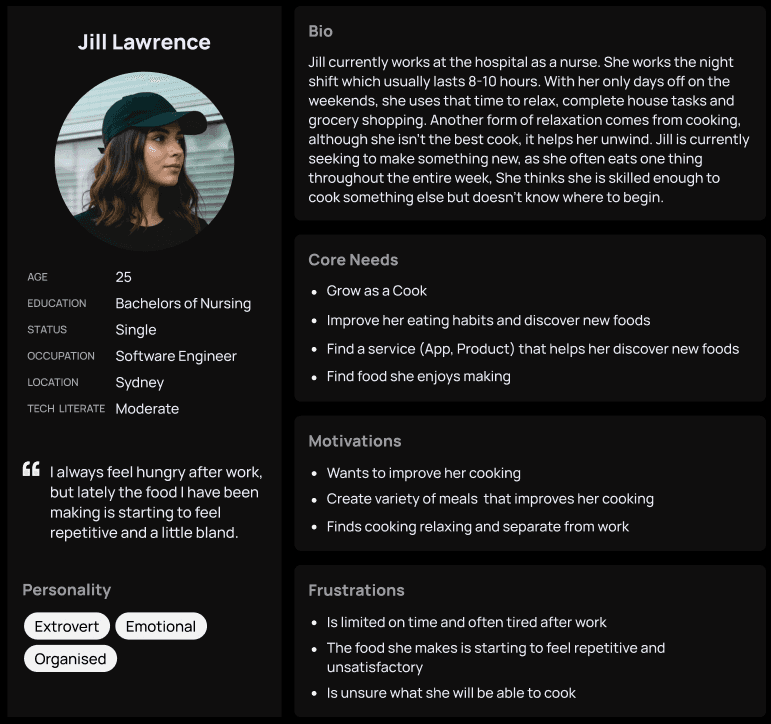
User Personas
User Personas - Semi fictional profile that represents a key segment of the target audience. Highlights user goals, behaviors, frustrations and demographics that inform the designer to target certain points of focus.
User Insights
Factors such as parental figures affected this statistic and were not purely takeout/eat out. Factors that had dissuaded cooking were time, a majority experience and skill expressed by two whilst, and a lack of need to cook, either via food provided by others or a general lack of interest. Whilst time to prepare and cooking can prevent someone from cooking at home, other factors such as ease of ordering food, reliance on others were expressed to be a greater factor rather than time scarcity. Amongst participants involved, participants suggested features such as skill-based tailoring, advanced categorization and library, and time-based suggestions that could accommodate for time constraints.
User Needs
To create a first prototype, we must identify the target audience’s needs and goals. Who is the target audience? Home cooks of all skill levels. Audience needs; personalized recipes, skill level and time-based recommendation systems, simple catered meals anyone can make without the need of special equipment. The goals? Reduce allocated time in the kitchen, free up time and resources, discover new recipes. The product will be developed into an app. Accessibility inside and outside the kitchen is important, increasing convenience, whilst considering the surroundings of the place the app is used, the kitchen. It needed to be portable, so that recipes could be easy to follow whilst freeing up space in what could be a cluttered or messy kitchen.
User Personas
User Personas - Semi fictional profile that represents a key segment of the target audience. Highlights user goals, behaviors, frustrations and demographics that inform the designer to target certain points of focus.
Yes: 2
No: 1
Sometimes: 3
Depends: 3

My Role
UX Lead
Interaction Design
Usability Testing
Prototyping
User Flows
Deliverables
High Fidelity Prototype
User Research
Project Type
Case Study
Individual Case
Time Period
Year - 2023
Duration - 4 Weeks
Brief
Creating a food app that prioritizes needs of the end user through app tailoring. Tailoring done around the user’s skill and capability levels easy to follow and navigate through. App focused on variety of meals, with quick preparation and completion of meals used to encourage the user rather than relying on delivery or takeout options. The UI needed to accommodate for this factor, whilst also providing advanced options for multiple types of meals with varying effort required. Dishes are split into categories depending on the main component that is used i.e. (chicken, beef) or type of dish i.e. (rice, pasta).
Challenge
Create an accessible food app for all ages, streamlining the cooking process by making recipes easily accessible, and catering to individual skill of the user. Offering information and guidance with the help of professionals that make the learning process easily followable.
User Research
User research was conducted through one-on-one user interviews. Questions asked revolved around time allocation, factors affecting meal preparation and cooking, general experience with food apps, recipe books, videos and other forms of external factors that interests them to cook. The survey focuses on identifying the target users, challenges, and effort involved when creating meals.
How often do you cook yourself?
Do you find cooking enjoyable?
Are there any factors that dissuade you from cooking?
Do you find yourself looking at recipes, videos, blog posts etc. on new recipe inspiration?
Are there factors that prevent you from cooking other than skill level?
What ways could cooking be presented to entice someone who has little to no experience with it?
Is time and preparation a significant dissuasion for preventing someones cooking?
What type of features would you suggest in an food app to encourage its use?
Self-Satisfaction: 2
Taste: 3
Stress Relief: 1
Act and Preparation: 1
Experience: 1
Yes: 1
No: 2
Sometimes: 3
Yes: 2
No: 1
Sometimes: 3
Depends: 3
User Insights
Factors such as parental figures affected this statistic and were not purely takeout/eat out. Factors that had dissuaded cooking were time, a majority experience and skill expressed by two whilst, and a lack of need to cook, either via food provided by others or a general lack of interest. Whilst time to prepare and cooking can prevent someone from cooking at home, other factors such as ease of ordering food, reliance on others were expressed to be a greater factor rather than time scarcity. Amongst participants involved, participants suggested features such as skill-based tailoring, advanced categorization and library, and time-based suggestions that could accommodate for time constraints.
User Needs
To create a first prototype, we must identify the target audience’s needs and goals. Who is the target audience? Home cooks of all skill levels. Audience needs; personalized recipes, skill level and time-based recommendation systems, simple catered meals anyone can make without the need of special equipment. The goals? Reduce allocated time in the kitchen, free up time and resources, discover new recipes. The product will be developed into an app. Accessibility inside and outside the kitchen is important, increasing convenience, whilst considering the surroundings of the place the app is used, the kitchen. It needed to be portable, so that recipes could be easy to follow whilst freeing up space in what could be a cluttered or messy kitchen.
User Personas
User Personas - Semi fictional profile that represents a key segment of the target audience. Highlights user goals, behaviors, frustrations and demographics that inform the designer to target certain points of focus.
User Insights
Factors such as parental figures affected this statistic and were not purely takeout/eat out. Factors that had dissuaded cooking were time, a majority experience and skill expressed by two whilst, and a lack of need to cook, either via food provided by others or a general lack of interest. Whilst time to prepare and cooking can prevent someone from cooking at home, other factors such as ease of ordering food, reliance on others were expressed to be a greater factor rather than time scarcity. Amongst participants involved, participants suggested features such as skill-based tailoring, advanced categorization and library, and time-based suggestions that could accommodate for time constraints.
User Needs
To create a first prototype, we must identify the target audience’s needs and goals. Who is the target audience? Home cooks of all skill levels. Audience needs; personalized recipes, skill level and time-based recommendation systems, simple catered meals anyone can make without the need of special equipment. The goals? Reduce allocated time in the kitchen, free up time and resources, discover new recipes. The product will be developed into an app. Accessibility inside and outside the kitchen is important, increasing convenience, whilst considering the surroundings of the place the app is used, the kitchen. It needed to be portable, so that recipes could be easy to follow whilst freeing up space in what could be a cluttered or messy kitchen.
User Personas
User Personas - Semi fictional profile that represents a key segment of the target audience. Highlights user goals, behaviors, frustrations and demographics that inform the designer to target certain points of focus.
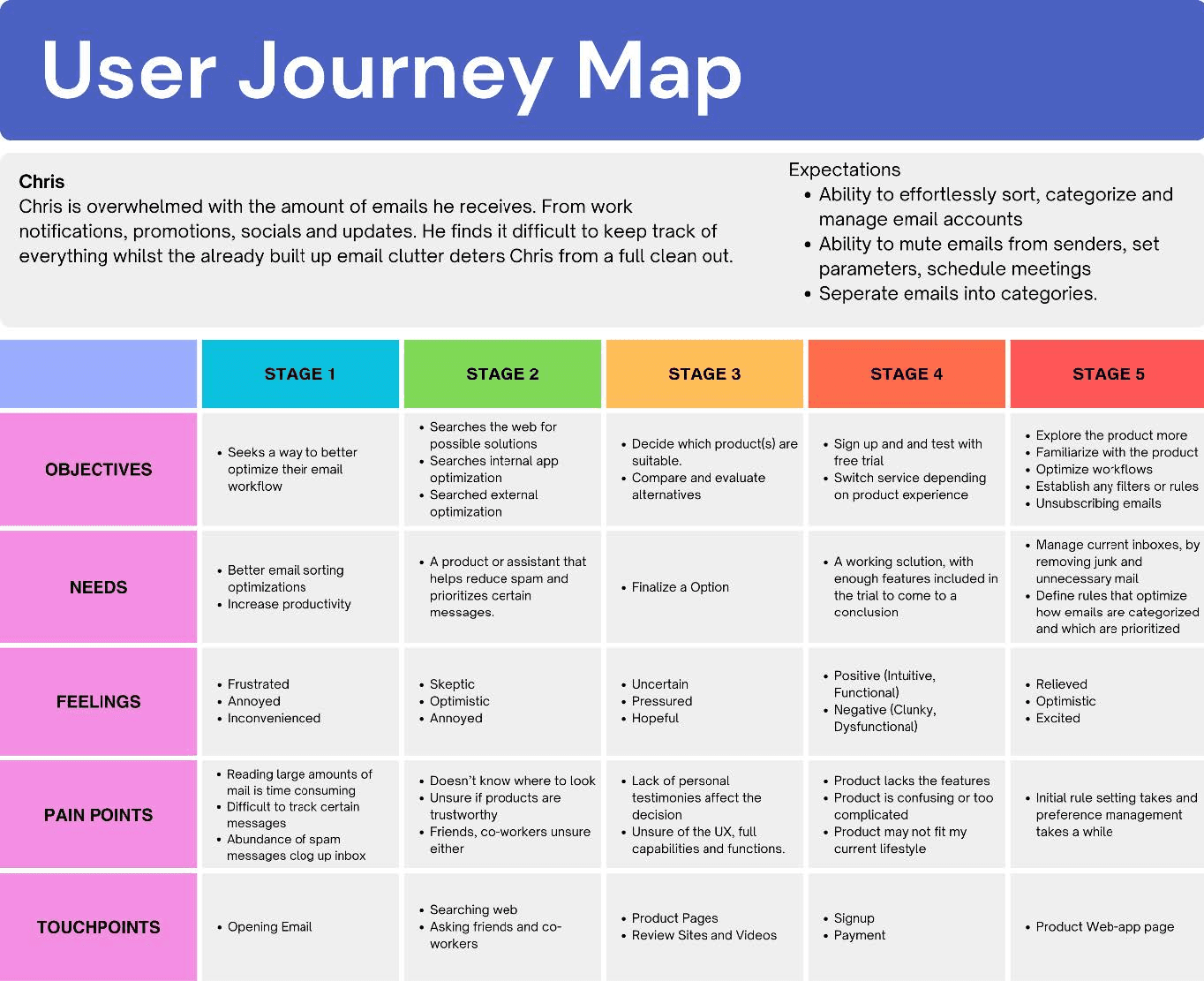
Journey Map
The user journey map below highlights key aspects from initial discovery to post-purchase usage. It highlights needs and pain points that come in each stage. Touch points highlights points where the user interacts and engages with.

My Role
UX Lead
Interaction Design
Usability Testing
Prototyping
User Flows
Deliverables
High Fidelity Prototype
User Research
Project Type
Case Study
Individual Case
Time Period
Year - 2025
Duration - 8 Weeks
Brief
In today’s world, email has become an essential part of communication and business. It is not only a means of communication but a highly effective marketing tool. Today an estimated 4.6 billion people use email. The average office worker receives up to 80-121 emails a day, 49% of those contributing to spam. On average employees spend an average of 11-15 hours per week managing and organising emails. A study conducted within Microsoft confirms that the average employee receives up to 117 emails per day and an additional 153 Teams messages, and on average employees are interrupted every two minutes from such notifications. This global study, which analysed 31,000 Swiss workers revealed that 48% of those workers reported that work weeks often felt chaotic and fragmented, with suggestions of AI to help sort workloads by assisting in daily routines.
Tools such as email sorters are fairly powerful tools but are vastly under-utilised whilst also fairly niche. Such tools allow for improved organisation, work efficiency and time management, and enhanced collaboration and teamwork. In response I aim to design an email sorter, but also a work-based sorting system that optimises work flows by sorting inquiries, meetings, global company notifications and more.
Challenge
Email is a commonly used source of communication and information however the ease of accessing important or prioritised emails can be hindered by overloaded inboxes and unwanted emails and other kinds of clutter. These emails can pile onto each other thus hindering productivity. This is especially detrimental when needing to track important emails relating to things such as business and finance. Thus, there is a need to create an effective method where emails are easily sorted, tracked and controlled.
User Research
Email is a commonly used source of communication and information however the ease of accessing important or prioritised emails can be hindered by overloaded inboxes and unwanted emails and other kinds of clutter. These emails can pile onto each other thus hindering productivity. This is especially detrimental when needing to track important emails relating to things such as business and finance. Thus, there is a need to create an effective method where emails are easily sorted, tracked and controlled.
How often do you use Email, work and personal?
How often do you spend using email a week (reading, sending, other)?
Is there a positive or negative user experience when using email. How and why?
Is email clutter a particular issue for you. What are the issues relating to email clutter?
Do you often receive emails that have little relevance to your current life. Has it ever hindered or discouraged the use of email?
Could email benefit from an improved sorting and prioritising system?
Does email have enough features that organise and sort messages?
Would a feature that provides automatic scanning allow for easier sorting, cleaning, prioritisation provide benefit. How could it be implemented?
How would you improve on email as an experience from user satisfaction, features, formats and UI?
User Personas
User Personas
Journey Map
The user journey map below highlights key aspects from initial discovery to post-purchase usage. It highlights needs and pain points that come in each stage. Touch points highlights points where the user interacts and engages with.
Ideation
User Flow
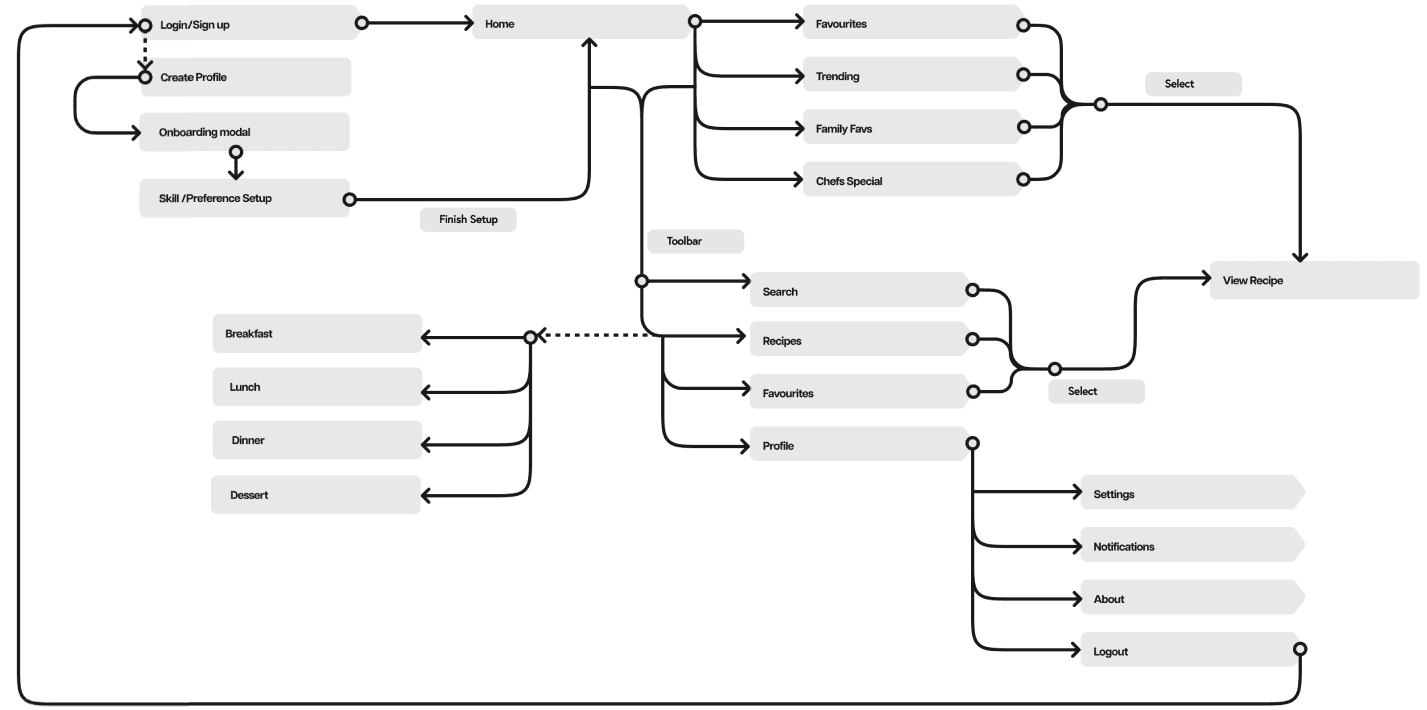
Before sketching and wire-framing, the user flow was created outlining the structure and app navigation. The outline showcasing the general flow of the app. The design is relatively simple, everything can be accessed via the the home, whilst toolbar works to gateways to other app sections. The pages will show a multiple of options, similar layout to a video streaming app.
1. Start at On-boarding which begins at the sign-up/login. Users begin with entering their details; email, username, password. App will ask questions based on skill-level, meal preferences and allergies then completing the on-boarding process.
2. Users are shown variety of meals which can be scrolled through sorted through different tabs and categories.
3. Save, share and follow recipes and view other users recommendations with community reviews and ratings.
4. See collaborators and chef specialties, learning from master chefs.


User Personas
Results
User research comprised of three full-time working adults, 2 male and one female. The ages of those interviewed, included a 24 and 56-year-old male and a 57-year-old female. All three interviewed frequently and heavily use email within the working week, one of them rarely uses personal email.
Time spent using email
Out of 3 respondents 2 said, 5 days a week, whilst the other 6-7 days a week.
Positive and negative experiences using email
A general consensus conveyed that email, allows communication to people, other tools are better for direct communication, and design is mostly utilitarian serving only to complete its function. Has it’s necessary features, but not much else.
Receiving spam and sorting through clutter
Two respondents don’t have any issues, deleting most unwanted emails and only reading relevant ones. Second respondent has many junk mails, mostly shopping and promotions and usually has to spend time manually clearing them.
Email sorting systems
All respondents said it would be helpful for more organization tools to be added, manual flagging could be improved via keyword screening or sorting highlighting senders. Whilst email has sorting features, specific targeting of certain mails can be improved to make them easy to find.
Improving sorting systems and email
Has a good experience using outlook, but could possibly improve it. Automatic sorting would still need to be screened without deleting without permission.
User Insights
There were total three participants interviewed. All respondents noted that email was perfectly functional for work related purposes. All respondents noted that email had all its necessary functions making it perfect at what it needs to do: send and read messages. However, two of them noted that organization functionality could be improved. 2 users would sort emails using some of noting that flagging systems or search were the best ways to keep track of emails, however all needed to be manually checked. 2 users were unsure of how to improve sorting and email prioritization whilst one suggested more categorization and filtering options, whilst the other felt it worked perfectly fine.
User Needs
To create a first prototype, we must identify the target audience’s needs and goals. Who is the target audience? Office workers, contractors, corporate jobs, and workers of this variety. This product will be most likely used by those who belong in these industries whilst are most likely to be aged 22+. The goal is to help reduce the time inside work and outside work hours spending time sorting through emails, whilst also sorting out those emails to their exact locations improving efficiency and productivity. It has first been adopted into a mobile app, but desktop is also a priority.
Journey Map
The user journey map below highlights key aspects from initial discovery to post-purchase usage. It highlights needs and pain points that come in each stage. Touch points highlights points where the user interacts and engages with.
Journey Map
The user journey map below highlights key aspects from initial discovery to post-purchase usage. It highlights needs and pain points that come in each stage. Touch points highlights points where the user interacts and engages with.
Low Fidelity Sketch Prototype
The development of the user flow adapted into app screens to see the flow and organization of elements needed for the app. The app has a stacked layout, presenting many different options to the user, without taking too much screen real estate. The app has a stacked layout with vertical and horizontal scrolling. This provides the user many options whilst reducing the individual menus and screens, whilst reducing the amount of vertical scrolling.
Prototype Screens
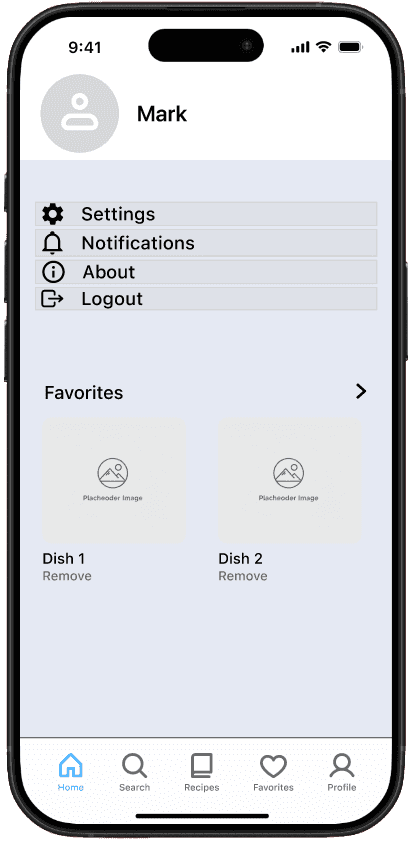
High-Fidelity Prototype
Created based off the low fidelity sketch prototype to digital format visualization, with consideration of format and the user experience. The user interface is made to resemble a real app, that could be used for a final design. Includes screens of described features and pages through result of ideation stage.




Home
Trending
Recipes
Recipe Guide
Favorites
Chef Special's
Search
Profile
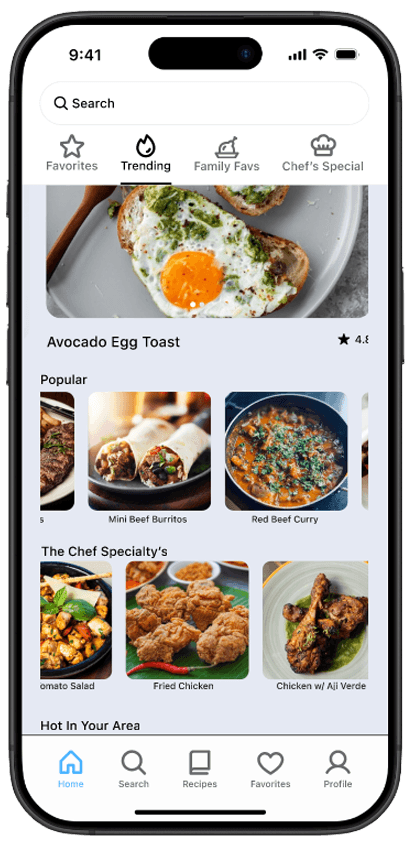

Diverse Selection
Browse through a diverse selection of food, ranging from different cultures and tastes, to time and occasions. The selection caters to different sizes from family feasts or a eat for one or two people. A range of food is offered and ready for those in a pinch and for some that require a bit more prep time.v By liking and adding to favorites, by you and the community the selections will shift to highlight those enjoyed by others and your own personal liking.
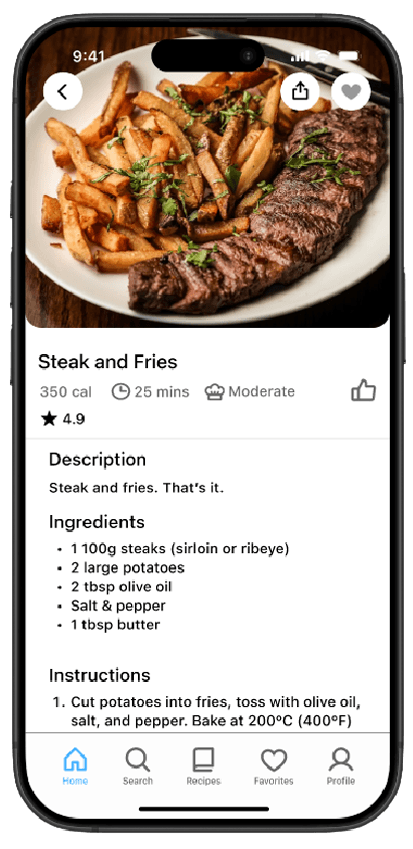

Recipe Guides
Learn how to make with organized instructions and ingredients. Follow a step by step guided process marked with a experience icon informative for all skill levels, beginner to expert. Save, share and like recipes to add to favorites and curate a personal collection of recipes you like the most.


Chef Special's
Renowned dishes from industry professional's. Learn the signature dishes and master your techniques to level up your cooking. But it doesn't just contain dishes catered to professionals. Included are simple recipes made to cater to home cooks, so don't worry about ingredients or advanced kitchen equipment to make them.

Final


Onboarding
The on-boarding process eases the users in, with clear instructions with a quick and simple sign-up process. After signing up, user's can set their preferences, exclude and alter food based around allergies and diets, and adjust based on cooking skill level.
User testing and Feedback
One-on-one usability tests were conducted observing user behavior, interaction and response towards the prototype. Participants' reception noted both positive and negative reactions, whilst providing valuable feedback. Participants were asked to complete tasks whilst navigation time and verbal response were observed and recorded.
Some users expressed that structure and navigation could use improvement. One suggestion was the addition of a navigation bar or menu underneath of navigation bar, displaying different categories including different meats, vegetables, and bases ie. rice or noodles.The tester suggested a revamp of the app structure, adopting a larger grid based structure, enlarging items whilst, including greater detail of the item itself underneath the item itself.
A separate user interviewed suggested removing the search bar at the top of each screen or simply converting it into a small icon, freeing up screen real estate which could then be replaced with filtering tags or options. Prioritizing minimalism would modernize the design whilst also minimizing distractions contributing to a neater UI. This user suggested that instead of the categories being sorted as breakfast, lunch, dinner, desert more universal options could be added. Sub-menu's or secondary navigation could help filter the results for better overall results.
Apart from UI improvements a major suggestion was adding in a community tab. Would act like a forum for discussion and sharing recipes which could upvoted and approved by industry professionals and moderated. This would add a sense of community and would leave a greater incentive to continue revisiting the app. Other suggestions included a short form stories that could quickly grab the attention of users that could be promoted by community members where the highest and most popular would feature on a story menu at top of the forum screen. However inclusion of shorts and stories would need to be limited as the app where it could be updated weekly or bi-weekly to avoid traps which detract from the original purpose of the app to which it would be become addictive to view.
Recommendations
Improved Layout, and navigation systems
UI enhancement and Simplification
Categorized Food Menus
Community Tab
Conclusion
Further development is needed to improve user experience, with improvements to the layout including new menus and possible reduction in options. This includes a tab to view by star ingredients, and plate type for example beef, chicken, fish or vegetable, rice or noodles etc. Adding categories with to menu page instead of Breakfast, Lunch, Dinner etc. instead adding those under time categories or filters within the page would allow for better flow between pages and elements.
Journey Map
The user journey map below highlights key aspects from initial discovery to post-purchase usage. It highlights needs and pain points that come in each stage. Touch points highlights points where the user interacts and engages with.
Ideation
User Flow
Before sketching and wire-framing, the user flow was created outlining the structure and app navigation. The outline showcasing the general flow of the app:
1. The on-boarding process begins with standard signup process; where users will enter their details linking their email account.
2. Users will be told some of the basic functionalities and features, guided through the process.
3. Most app functionalities are accessible from the dashboard(home), otherwise accessed through the side menu. The navigation is split into 3 drop-downs; profile settings, tools and quick access. Profile settings relate to app settings, payments, accounts, help and terms and conditions. Tools relate to functions that sort and clean emails, and quick access resembles your standard email UI, for easy access without switching between apps.
4. View summaries that show messages, cleared, filtered, sorted and blocked, keep tangible use and feedback after each clean. Will refresh bi-weekly,app will give updates in summaries with future.
Ideation
User Flow
Before sketching and wire-framing, the user flow was created outlining the structure and app navigation. The outline showcasing the general flow of the app:
1. The on-boarding process begins with standard signup process; where users will enter their details linking their email account.
2. Users will be told some of the basic functionalities and features, guided through the process.
3. Most app functionalities are accessible from the dashboard(home), otherwise accessed through the side menu. The navigation is split into 3 drop-downs; profile settings, tools and quick access. Profile settings relate to app settings, payments, accounts, help and terms and conditions. Tools relate to functions that sort and clean emails, and quick access resembles your standard email UI, for easy access without switching between apps.
4. View summaries that show messages, cleared, filtered, sorted and blocked, keep tangible use and feedback after each clean. Will refresh bi-weekly,app will give updates in summaries with future.
Ideation
User Flow
Before sketching and wire-framing, the user flow was created outlining the structure and app navigation. The outline showcasing the general flow of the app:
1. The on-boarding process begins with standard signup process; where users will enter their details linking their email account.
2. Users will be told some of the basic functionalities and features, guided through the process.
3. Most app functionalities are accessible from the dashboard(home), otherwise accessed through the side menu. The navigation is split into 3 drop-downs; profile settings, tools and quick access. Profile settings relate to app settings, payments, accounts, help and terms and conditions. Tools relate to functions that sort and clean emails, and quick access resembles your standard email UI, for easy access without switching between apps.
4. View summaries that show messages, cleared, filtered, sorted and blocked, keep tangible use and feedback after each clean. Will refresh bi-weekly,app will give updates in summaries with future.
Low Fidelity Sketch Prototype
The development of the user flow adapted into app screens to see the flow and organization of elements needed for the app. The app has a stacked layout, presenting many different options to the user, without taking too much screen real estate. The app has a stacked layout with vertical and horizontal scrolling. This provides the user many options whilst reducing the individual menus and screens, whilst reducing the amount of vertical scrolling.
Low Fidelity Sketch Prototype
The development of the user flow adapted into app screens to see the flow and organization of elements needed for the app. The app has a stacked layout, presenting many different options to the user, without taking too much screen real estate. The app has a stacked layout with vertical and horizontal scrolling. This provides the user many options whilst reducing the individual menus and screens, whilst reducing the amount of vertical scrolling.

Prototype Screens
High-Fidelity Prototype
Created based off the low fidelity sketch prototype to digital format visualization, with consideration of format and the user experience. The user interface is made to resemble a real app, that could be used for a final design. Includes screens of described features and pages through result of ideation stage.
High-Fidelity Prototype
Created based off the low fidelity sketch prototype to digital format visualization, with consideration of format and the user experience. The user interface is made to resemble a real app, that could be used for a final design. Includes screens of described features and pages through result of ideation stage.
Search
Recipe Guide
Chef Special's
Trending
Favorites
Home
Profile
Recipes
Home
Trending
Recipes
Recipe
Favorites
Recipe Guide
Recipe
Chef's Special
Search
Profile
Search
Recipe Guide
Chef Special's
Home
Favorites
Profile
Trending
Recipes
Final
Onboarding
The on-boarding process eases the users in, with clear instructions with a quick and simple sign-up process. After signing up, user's can set their preferences, exclude and alter food based around allergies and diets, and adjust based on cooking skill level.
Onboarding
The on-boarding process eases the users in, with clear instructions with a quick and simple sign-up process. After signing up, user's can set their preferences, exclude and alter food based around allergies and diets, and adjust based on cooking skill level.
Onboarding
The on-boarding process eases the users in, with clear instructions with a quick and simple sign-up process. After signing up, user's can set their preferences, exclude and alter food based around allergies and diets, and adjust based on cooking skill level.
Onboarding
The on-boarding process eases the users in, with clear instructions with a quick and simple sign-up process. After signing up, user's can set their preferences, exclude and alter food based around allergies and diets, and adjust based on cooking skill level.
Diverse Selection
Browse through a diverse selection of food, ranging from different cultures and tastes, to time and occasions. The selection caters to different sizes from family feasts or a eat for one or two people. A range of food is offered and ready for those in a pinch and for some that require a bit more prep time.v By liking and adding to favorites, by you and the community the selections will shift to highlight those enjoyed by others and your own personal liking.
Recipe Guides
Learn how to make with organized instructions and ingredients. Follow a step by step guided process marked with a experience icon informative for all skill levels, beginner to expert. Save, share and like recipes to add to favorites and curate a personal collection of recipes you like the most.
Diverse Selection
Browse through a diverse selection of food, ranging from different cultures and tastes, to time and occasions. The selection caters to different sizes from family feasts or a eat for one or two people. A range of food is offered and ready for those in a pinch and for some that require a bit more prep time.v By liking and adding to favorites, by you and the community the selections will shift to highlight those enjoyed by others and your own personal liking.
Onboarding
Browse through a diverse selection of food, ranging from different cultures and tastes, to time and occasions. The selection caters to different sizes from family feasts or a eat for one or two people. A range of food is offered and ready for those in a pinch and for some that require a bit more prep time.v By liking and adding to favorites, by you and the community the selections will shift to highlight those enjoyed by others and your own personal liking.
Diverse Selection
Browse through a diverse selection of food, ranging from different cultures and tastes, to time and occasions. The selection caters to different sizes from family feasts or a eat for one or two people. A range of food is offered and ready for those in a pinch and for some that require a bit more prep time.v By liking and adding to favorites, by you and the community the selections will shift to highlight those enjoyed by others and your own personal liking.
Chef's Special
Renowned dishes from industry professional's. Learn the signature dishes and master your techniques to level up your cooking. But it doesn't just contain dishes catered to professionals. Included are simple recipes made to cater to home cooks, so don't worry about advanced kitchen equipment or skills to make them.
Recipe Guides
Learn how to make with organized instructions and ingredients. Follow a step by step guided process marked with a experience icon informative for all skill levels, beginner to expert. Save, share and like recipes to add to favorites and curate a personal collection of recipes you like the most.
Chef's Special
Renowned dishes from industry professional's. Learn the signature dishes and master your techniques to level up your cooking. But it doesn't just contain dishes catered to professionals. Included are simple recipes made to cater to home cooks, so don't worry about advanced kitchen equipment or skills to make them.
Onboarding
The on-boarding process eases the users in, with clear instructions with a quick and simple sign-up process. After signing up, user's can set their preferences, exclude and alter food based around allergies and diets, and adjust based on cooking skill level.
Diverse Selection
Browse through a diverse selection of food, ranging from different cultures and tastes, to time and occasions. The selection caters to different sizes from family feasts or a eat for one or two people. A range of food is offered and ready for those in a pinch and for some that require a bit more prep time.v By liking and adding to favorites, by you and the community the selections will shift to highlight those enjoyed by others and your own personal liking.
Recipe Guides
Learn how to make with organized instructions and ingredients. Follow a step by step guided process marked with a experience icon informative for all skill levels, beginner to expert. Save, share and like recipes to add to favorites and curate a personal collection of recipes you like the most.
Chef Special's
Renowned dishes from industry professional's. Learn the signature dishes and master your techniques to level up your cooking. But it doesn't just contain dishes catered to professionals. Included are simple recipes made to cater to home cooks, so don't worry about ingredients or advanced kitchen equipment or skills to make them.
User testing and Feedback
One-on-one usability tests were conducted observing user behavior, interaction and response towards the prototype. Participants' reception noted both positive and negative reactions, whilst providing valuable feedback. Participants were asked to complete tasks whilst navigation time and verbal response were observed and recorded.
Some users expressed that structure and navigation could use improvement. One suggestion was the addition of a navigation bar or menu underneath of navigation bar, displaying different categories including different meats, vegetables, and bases ie. rice or noodles.The tester suggested a revamp of the app structure, adopting a larger grid based structure, enlarging items whilst, including greater detail of the item itself underneath the item itself.
A separate user interviewed suggested removing the search bar at the top of each screen or simply converting it into a small icon, freeing up screen real estate which could then be replaced with filtering tags or options. Prioritizing minimalism would modernize the design whilst also minimizing distractions contributing to a neater UI. This user suggested that instead of the categories being sorted as breakfast, lunch, dinner, desert more universal options could be added. Sub-menu's or secondary navigation could help filter the results for better overall results.
Apart from UI improvements a major suggestion was adding in a community tab. Would act like a forum for discussion and sharing recipes which could upvoted and approved by industry professionals and moderated. This would add a sense of community and would leave a greater incentive to continue revisiting the app. Other suggestions included a short form stories that could quickly grab the attention of users that could be promoted by community members where the highest and most popular would feature on a story menu at top of the forum screen. However inclusion of shorts and stories would need to be limited as the app where it could be updated weekly or bi-weekly to avoid traps which detract from the original purpose of the app to which it would be become addictive to view.
Recommendations
Improved Layout, and navigation systems
UI enhancement and Simplification
Categorized Food Menus
Community Tab
Conclusion
Further development is needed to improve user experience, with improvements to the layout including new menus and possible reduction in options. This includes a tab to view by star ingredients, and plate type for example beef, chicken, fish or vegetable, rice or noodles etc. Adding categories with to menu page instead of Breakfast, Lunch, Dinner etc. instead adding those under time categories or filters within the page would allow for better flow between pages and elements.
User testing and Feedback
One-on-one usability tests were conducted observing user behavior, interaction and response towards the prototype. Participants’ reception noted both positive and negative reactions, whilst providing valuable feedback. Participants were asked to complete tasks whilst navigation time and verbal response were observed and recorded.
Some users expressed that structure and navigation could use improvement. One suggestion was the addition of a navigation bar or menu underneath of navigation bar, displaying different categories including different meats, vegetables, and bases ie. rice or noodles.The tester suggested a revamp of the app structure, adopting a larger grid based structure, enlarging items whilst, including greater detail of the item itself underneath the item itself.
A separate user interviewed suggested removing the search bar at the top of each screen or simply converting it into a small icon, freeing up screen real estate which could then be replaced with filtering tags or options. Prioritizing minimalism would modernize the design whilst also minimizing distractions contributing to a neater UI. This user suggested that instead of the categories being sorted as breakfast, lunch, dinner, desert more universal options could be added. Sub-menu’s or secondary navigation could help filter the results for better overall results.
Apart from UI improvements a major suggestion was adding in a community tab. Would act like a forum for discussion and sharing recipes which could upvoted and approved by industry professionals and moderated. This would add a sense of community and would leave a greater incentive to continue revisiting the app. Other suggestions included a short form stories that could quickly grab the attention of users that could be promoted by community members where the highest and most popular would feature on a story menu at top of the forum screen. However inclusion of shorts and stories would need to be limited as the app where it could be updated weekly or bi-weekly to avoid traps which detract from the original purpose of the app to which it would be become addictive to view.
Recommendations
Improved Layout, and navigation systems
UI enhancement and Simplification
Categorized Food Menus
Community Tab
Conclusion
Further development is needed to improve user experience, with improvements to the layout including new menus and possible reduction in options. This includes a tab to view by star ingredients, and plate type for example beef, chicken, fish or vegetable, rice or noodles etc. Adding categories with to menu page instead of Breakfast, Lunch, Dinner etc. instead adding those under time categories or filters within the page would allow for better flow between pages and elements.
© Rocco Leung
roccoleungg@gmail.com
Resume
© Rocco Leung
roccoleungg@gmail.com
Resume
© Rocco Leung
roccoleungg@gmail.com
Resume
© Rocco Leung
roccoleungg@gmail.com
Resume